
Plan a Sun or Moon Observation Without Mixing UTC, Bearings and the Local Horizon
Write the instant before entering coordinates
A date and clock time without a time zone are incomplete. SkyLedger's Sun and Moon tool labels its datetime input UTC. It treats those entered numbers as UTC rather than automatically converting the computer's local time. For an observation planned in local civil time, determine the applicable offset for that date first, including daylight-saving rules where relevant.
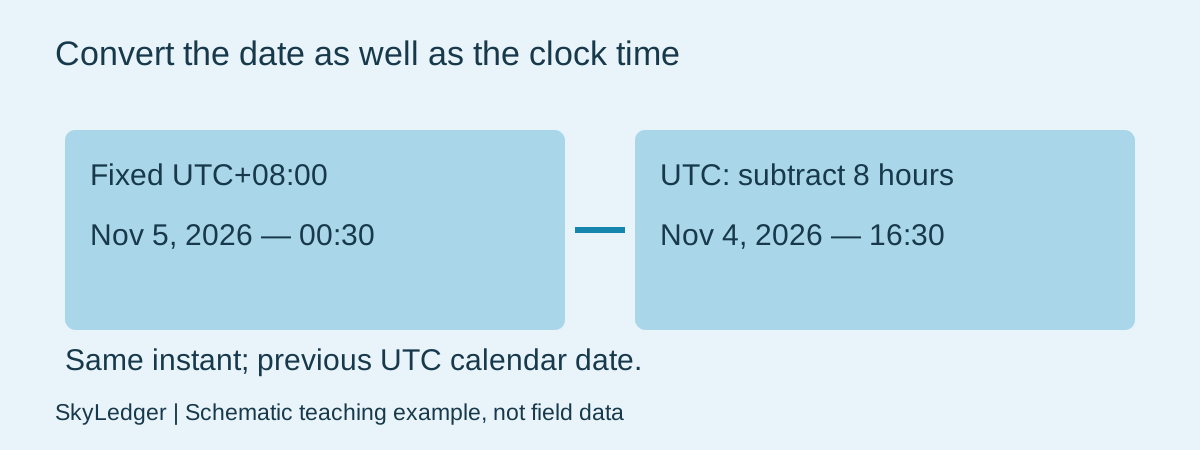
Synthetic conversion exercise: 00:30 on November 5, 2026 at a fixed UTC+08:00 offset corresponds to 16:30 UTC on November 4. Subtract eight hours and carry the date backward. Enter 2026-11-04 16:30 in the UTC field, not November 5 at 00:30. The example uses a stated fixed offset; it does not infer a city's time-zone history from longitude.
Check sign conventions and read the output geometrically
Latitude is positive north and negative south. Longitude is positive east and negative west. A synthetic location at 29° north, 68° west therefore uses latitude 29 and longitude −68. A reversed longitude sign can move the calculated observing position across a large part of the world while still producing plausible-looking numbers. Cross-check coordinates against a map before treating the output as a local prediction.
Altitude describes angle above or below the modeled horizon; azimuth is clockwise from north, with east at 90°, south at 180° and west at 270°. A negative Moon altitude means it is below that modeled horizon at the selected instant. Illumination fraction describes how much of the lunar disk is illuminated, not whether the Moon is visible through cloud, terrain or daylight glare.
Understand what the horizon model leaves out
The site's positions are computed with Astronomy Engine for an observer at zero elevation, using its normal refraction model. Terrain, nearby buildings and local atmospheric conditions are not supplied to the calculation. If a ridge blocks the east, a tabulated rise need not be the moment the object becomes visible from your chosen viewpoint.
The US Naval Observatory's definitions explain how rise and set depend on the object's apparent disk and atmospheric assumptions. NOAA's solar-calculation notes also discuss refraction and the limits of predicted timing. Those references explain the underlying problem; their published accuracy estimates belong to their own methods and should not be copied as a performance guarantee for this site.
Handle a day without a rise or a set
The polar-day tool examines a particular UTC midnight-to-midnight interval. At high latitude, a selected day may have no sunrise or sunset. That is a valid possible result, not an instruction to replace the missing event with 00:00. An event may also fall on a different civil date after conversion to your local time. Always retain the UTC date alongside a converted clock time.
Build a short observing card containing coordinates, UTC instant, local-time conversion, expected bearing, modeled altitude and an actual horizon note. Check cloud and official weather information separately. Do not look directly at the Sun or through optical equipment without appropriate specialist protection. These planning calculations do not make solar viewing safe or predict cloud-free visibility.
Sources & further reading
- US Naval Observatory: rise, set and twilight definitions
- NOAA GML: solar calculation details and refraction
- Astronomy Engine: project methods and documentation
Reviewed November 4, 2026. The diagrams and examples are schematic teaching aids, not field photographs or measured records.
Use the related observation tool