
A Weather CSV That Opens Correctly Can Still Be Wrong
Preserve the file before cleaning it
Save an untouched copy and write down the export settings: station, time zone, cadence, units, pressure product and missing-value convention. A spreadsheet opening a file without complaint only establishes that it could display something. It does not establish that 10 means degrees Celsius, that timestamps are UTC or that the sensor was correctly exposed.
SkyLedger's checker expects time_utc,temp_c,rh_percent,pressure_hpa. The headers carry the unit contract. It reads local text or a local file, does not upload it, and reports problems without editing the original. Its 1 MB and 1,000-data-row limits make it a small-file diagnostic, not a full archive-processing service.
Reproduce three different kinds of problem
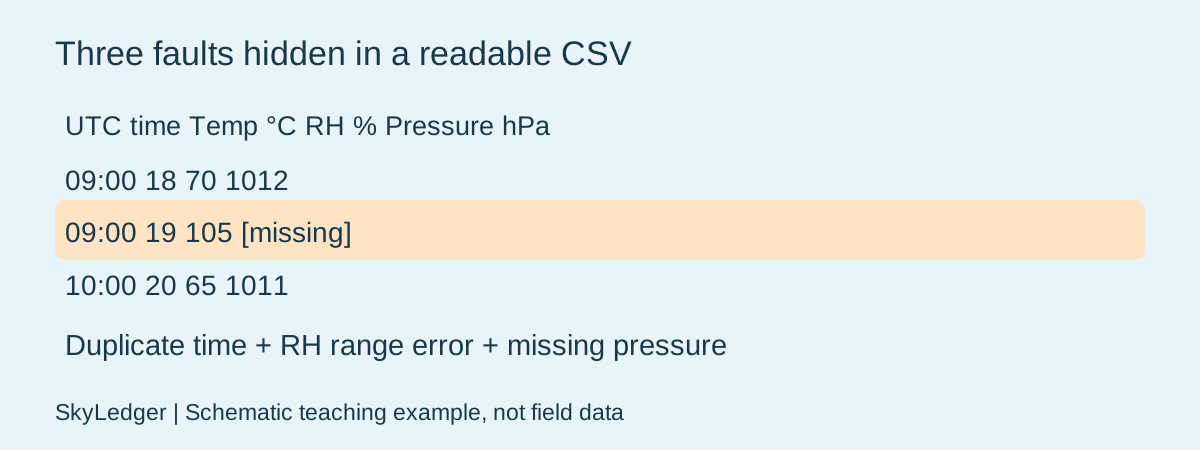
Download the synthetic example below. It contains 09:00 UTC with 18°C, 70% RH and 1012 hPa; another 09:00 record with 19°C, 105% RH and blank pressure; then 10:00 with 20°C, 65% RH and 1011 hPa. The checker should identify the duplicate time, humidity outside its allowed range and missing pressure. These are deliberately constructed faults, not observations from a named station.
A fully empty record written as ,,, should also be reported as missing fields rather than disappearing silently. A truly blank physical line is different from a delimited record. CSV record numbers need not match a text editor's physical line numbers when blank lines or quoted multiline cells are involved. Use the actual values to locate the record.
Repair only what the evidence supports
A duplicate might be a retransmission, a corrected reading or two instruments mixed into one export. Check the original logger before dropping either row. Keep both until their meaning is resolved. RH of 105% might indicate a sensor problem, wrong unit or parsing error; do not silently cap it at 100% and call the record measured saturation.
A missing pressure is unknown, not zero. If the original file supplies a recoverable value, document the recovery. Otherwise keep the gap. The UTC suffix Z means UTC: adding it to an unchanged local-time string relabels the instant incorrectly. Convert using the known offset or time-zone rules, and flag ambiguous daylight-saving timestamps when the source lacks enough information.
A clean report is only the next starting point
After making a separate reviewed copy, run the checker again and record which flags disappeared and why. Inspect cadence and station metadata manually. A temperature within the accepted numeric range can still be biased by a sunlit wall; perfectly ordered timestamps can still be assigned the wrong time zone. Passing automated checks is not a calibration certificate.
The downloadable file's format follows the site's explicit schema, not a WMO or CoCoRaHS submission format. The W3C tabular-data model is useful background on rows, columns, datatypes and metadata. The site's specific field limits and duplicate rules are our implementation choices. When publishing a cleaned dataset, include those choices and the change log so another person can audit the decisions.
Sources & further reading
- W3C: model for tabular data and metadata
- NWS / CWOP: personal weather station siting, including illustrated placement problems
Reviewed November 4, 2026. The diagrams and examples are schematic teaching aids, not field photographs or measured records.
Use the related observation tool