
What a Thunder Delay Can Estimate—and Why It Cannot Tell You to Stay Outside
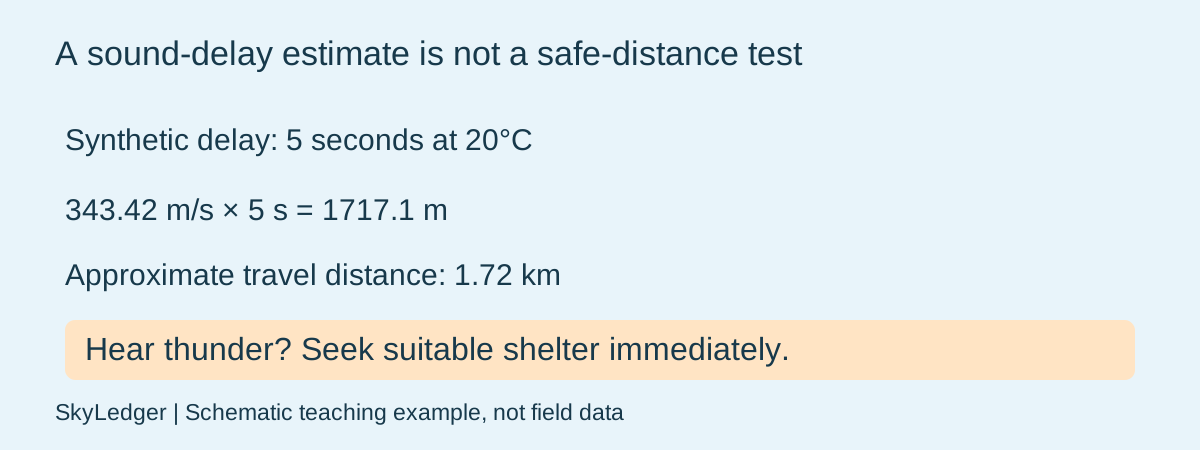
Use the safety rule before the arithmetic
If you hear thunder, move immediately to suitable shelter. The National Weather Service identifies a substantial building with electricity or plumbing, or an enclosed metal-topped vehicle with windows up, as suitable options. Its guidance says to remain sheltered for at least 30 minutes after the last thunder. Do not stay outside to collect a sequence of delays for this calculator.
The following calculation is an explanation of sound travel and can be explored with invented times or a recording while already sheltered. It is not a test of whether you are outside a dangerous radius. One flash, one thunder sound and a displayed distance do not reveal where the next lightning discharge will occur.
Reproduce a synthetic five-second delay
The widget uses an approximate sound speed c = 331.3 + 0.606T metres per second, where T is ambient temperature in °C. At 20°C this gives 343.42 m/s. Multiplying a synthetic five-second delay by that speed gives 1717.1 m, approximately 1.72 km. At this scale, light's travel time is negligible compared with the sound delay.
Try the same delay at 0°C and 30°C: the approximate results are 1.6565 km and 1.7474 km. The temperature changes the arithmetic, but a reading at your own shelter is not a measurement of the temperature along the whole sound path. Wind, vertical structure and the complex discharge geometry remain outside this simple model. Extra displayed digits do not remove those limitations.
Timing precision is not location accuracy
Suppose your combined uncertainty in matching and timing the flash and first sound is ±0.5 seconds. At 20°C that alone corresponds to approximately ±172 m. This is a sensitivity example, not a complete error bar: it omits wrong flash-to-thunder matching, sound-path effects and uncertainty in which part of the channel produced the first audible sound.
A lightning channel extends through space, and rolling thunder can arrive from different parts at different times. Multiple flashes and overlapping sounds can make matching ambiguous. If you cannot confidently associate the sound with the flash, do not report the number as a located strike. A phone timer measures elapsed time; it does not turn the observation into a lightning-detection network.
Keep the log useful without encouraging exposure
For a retrospective educational record, save the assumed temperature, delay, formula and circumstances of the recording. Mark a simulated delay as simulated. Do not create a series by going back outside between rumbles or by treating a longer delay as an all-clear. The last thunder starts the shelter waiting period again under the NWS guidance.
An app output cannot evaluate whether a shelter is suitable, whether an installation is electrically safe or whether warnings cover your location. Use the official safety instructions and current local warnings for those decisions. The practical lesson is to distinguish a limited estimate of sound travel from a decision about personal exposure; the distance calculator answers only the first question.
Sources & further reading
Reviewed November 4, 2026. The diagrams and examples are schematic teaching aids, not field photographs or measured records.
Use the related observation tool