
Record Cloud Cover in Oktas Without Counting the Same Sky Twice
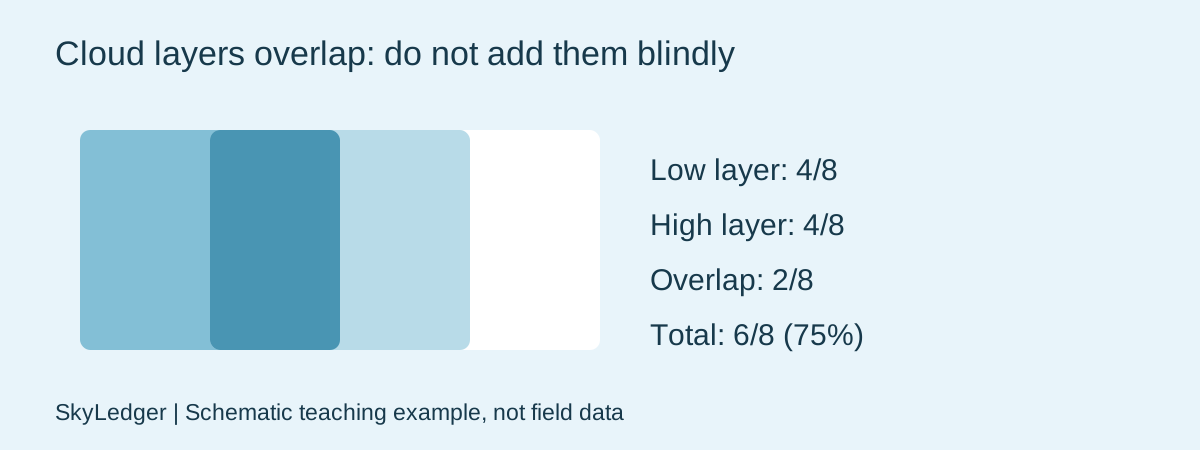
Cloud amount is an area estimate, not a cloud count
Total cloud cover is the fraction of the sky covered by all visible clouds. Ten small clouds can cover less sky than one broad sheet. WMO distinguishes total cover from the amount belonging to a particular cloud type or layer. Decide which quantity you are recording before choosing a number.
Use a place with a broad view and note blocked sectors. Do not turn a tree-covered part of the sky into assumed clear sky. A nearby roof is a local obstruction; it is not evidence that meteorological obscuration covers the whole sky. Observe without staring at the Sun, and end outdoor observations when conditions become hazardous.
Build an estimate systematically
Sweep the sky in sectors, including overhead and the horizon, while avoiding repeated counting of the same cloud. Mentally combine cloudy areas into the fraction of the visible sky dome they occupy. Sector sketches are a consistency aid, not a claim that equal-sized patches in a wide-angle photograph represent equal solid angles.
Record total cover separately from low, middle or high layers. In a synthetic example, a low layer covers half the sky and a high layer covers half, with a quarter-sky overlap. Their combined total is three quarters, or a nominal 6/8, not 8/8. Add covered areas and subtract their overlap; do not add layer amounts blindly.
Use the converter as a teaching scale
One okta is one eighth. On a nominal proportional scale, 3/8 is 37.5% and 6/8 is 75%. The site's converter makes that arithmetic visible, but a naked-eye estimate is not measured to a tenth of a percent. Save the original categorical estimate alongside any illustrative percentage.
The converter reserves clear and fully covered endpoints and handles obscured sky separately. Do not assume its nearest-step conversion is the exact reporting rule for every national service or network. If submitting an observation, use that network's instructions for near-clear, near-overcast and obscured conditions. A calculated decimal does not override an observing convention.
Separate overcast, uncertain and obscured
An overcast cloud layer covers the sky. An obscured sky means you cannot assess the sky because an obscuring phenomenon prevents the view; it is not simply a larger cloud fraction. In conventional numeric coding, 9 can denote obscured sky and must not be interpreted as nine eighths or 112.5% cloud. Keep the obscuration reason in the notes.
Useful synthetic entry: 11:00 UTC, total cover estimated 6/8, low clouds 4/8, high layer visible through gaps, western sector partly blocked by buildings; confidence limited. That record is more honest than an unexplained 75.0%. Repeat from the same viewing point if tracking change, record any change of viewpoint and compare cloud type using the genus guide rather than trying to infer type from cover alone.
Sources & further reading
Reviewed November 4, 2026. The diagrams and examples are schematic teaching aids, not field photographs or measured records.
Use the related observation tool