
Dew Point, Relative Humidity or Wet Bulb: Which Reading Answers Your Question?
Choose the question before the humidity number
Relative humidity compares vapor pressure with saturation vapor pressure at the air temperature. Dew point expresses the temperature at which that vapor pressure would reach saturation over water. Wet-bulb temperature comes from the cooling of a wetted sensor under specified ventilation. They describe related physics, but the readings are not interchangeable labels for how much water is in the air.
Use RH when asking how close the air is to saturation at its present temperature. Use dew point to compare moisture conditions while temperature changes, while remembering pressure and measurement context. Use a wet-bulb calculation only when the instrument setup fits its assumptions. A consumer hygrometer does not become an independent wet-bulb instrument because an app displays a derived value.
Worked example: RH rises without adding vapor
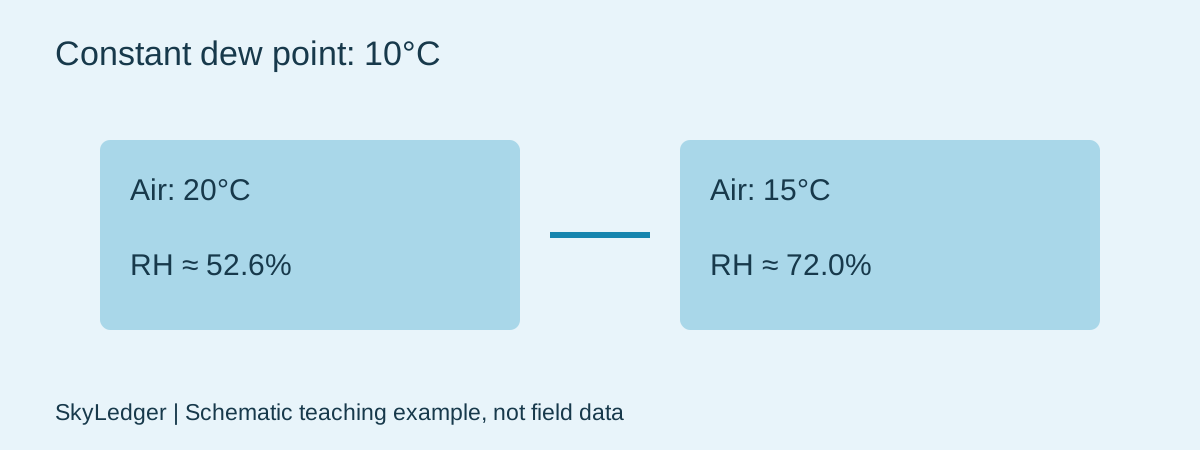
Teaching scenario: dew point remains 10°C while air cools from 20°C to 15°C. The site's over-water Magnus approximation gives RH about 52.6% at 20°C and 72.0% at 15°C. Enter both pairs in the dew-point-to-RH tool. The increase follows the smaller saturation vapor pressure at the lower temperature; it is not evidence that rain or evaporation added vapor.
This calculation assumes the stated dew point is unchanged. If cooling proceeds to saturation, condensation and changes in the air parcel need consideration. Below freezing, conventions for saturation over ice and water differ. Do not extrapolate a limited liquid-water teaching formula into an ice-coated instrument problem.
A wet-bulb calculation needs pressure and ventilation
For a reproducible synthetic example, enter dry bulb 20°C, water-covered wet bulb 15°C and station pressure 1000 hPa. The tool applies e = es(Tw) − 0.00066 × (1 + 0.00115Tw) × p × (T − Tw), then RH = 100e/es(T). With its Magnus saturation formula the result is approximately 58.6% RH. Rounding another saturation formula can shift the last digits.
The coefficient represents an empirical ventilated water-bulb approximation. Wick contamination, inadequate ventilation, radiant heating and insufficient settling time can invalidate it. Use station pressure, not a sea-level-adjusted number. A wet bulb warmer than the dry bulb or an impossible computed vapor pressure calls for checking the inputs and instrument, not accepting a clipped zero or hundred-percent result.
Resolve disagreement instead of averaging unlike products
Compare measurements taken together in the same exposure. Write down which quantities were measured and which were calculated. Many station displays derive dew point from the same temperature and RH sensors; agreement after converting that dew point back to RH is circular, not a second calibration test. An independent instrument comparison requires an independent reference.
The NWS humidity explanation provides everyday comparisons showing why RH alone can mislead when temperature changes. Our worked pairs adapt that physical principle into reproducible tool inputs; they are not copied station records. These calculators do not compute occupational heat limits or wet-bulb globe temperature. For a heat-safety decision, use the applicable official guidance and the actual exposure conditions.
Sources & further reading
- NWS Louisville: relative humidity and dew point
- NWS / CWOP: personal weather station siting, including illustrated placement problems
Reviewed November 4, 2026. The diagrams and examples are schematic teaching aids, not field photographs or measured records.
Use the related observation tool