
Why 350° and 10° Do Not Average to a Southerly Wind
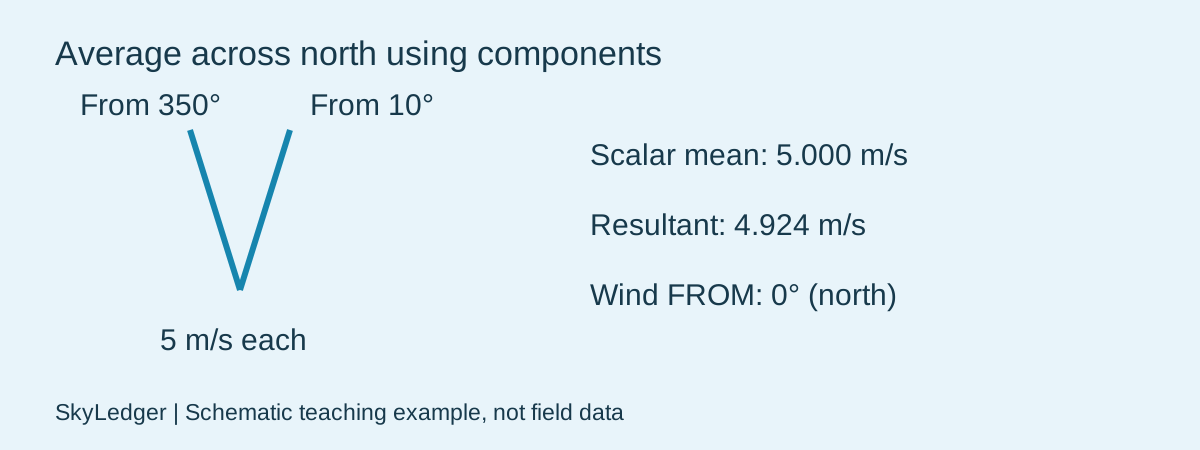
The arithmetic average fails at north
A direction is circular. Two equal-speed winds from 350° and 10° both come from near north, but the arithmetic average of their degree values is 180°. The failure occurs because 0° and 360° represent the same direction. Rearranging the numeric labels does not change the physical wind; an averaging rule should respect that geometry.
Meteorological direction describes where wind comes from, clockwise from north. A northerly wind moves south. Confusing a map arrow's travel direction with wind-from direction reverses the result by 180°. Before comparing datasets, write down the direction convention, speed unit, sampling interval and any calm or missing-value codes.
Calculate a two-record example
Synthetic CSV: speed_ms,direction_deg followed by 5,350 and 5,10. For each row use u = −s sin(θ) and v = −s cos(θ). The eastward components are approximately +0.868 and −0.868 m/s, so their mean is zero. Both northward components are approximately −4.924 m/s. The mean vector therefore points south and is reported as wind from 0°, at 4.924 m/s.
The mean of the two speeds is 5.000 m/s. That scalar mean answers how fast the sampled wind was moving on average; the smaller resultant speed describes the average velocity vector after directional cancellation. Neither is an instrument fault. Report which quantity you calculated instead of giving both the vague name average wind.
A real operational distinction: NDBC's method
NOAA's National Data Buoy Center describes two methods in its FAQ. For DACT, VEEP and ARES payload measurements it specifies a scalar average for speed and a unit-vector average for direction; for older GSBP payloads it describes true vector averaging. Unit-vector direction averaging removes speed magnitude before combining directions. SkyLedger's tool instead averages velocity components, so faster observations carry more influence on the resultant direction. This is a documented methodological comparison, not a claim that the buoy service uses our calculator.
For unequal speeds, those direction methods can differ materially. If reproducing a published product, use its exact convention and quality controls. Our CSV tool assumes equally weighted observations; it does not infer unequal sample duration from timestamps. Resample carefully or use a duration-weighted analysis when observation intervals differ.
Check cancellation, calms and incomplete records
Try a second synthetic pair: 5 m/s from 90° and 5 m/s from 270°. The mean scalar speed is still 5 m/s, while the vector cancels to zero. Its direction is undefined. That does not mean there was no wind during the interval; it means the sampled velocities cancelled. A small resultant can also make direction highly sensitive to small measurement errors.
Keep true calm separate from a missing speed. The tool permits a blank direction for zero-speed records, but a nonzero speed needs a valid direction. Do not invent a direction for missing data or average gust peaks with sustained measurements. Save the input, algorithm and both scalar and resultant metrics so another observer can reproduce your result.
Sources & further reading
Reviewed November 4, 2026. The diagrams and examples are schematic teaching aids, not field photographs or measured records.
Use the related observation tool